Qecliga Serif Font for Handmade Labels & Printables
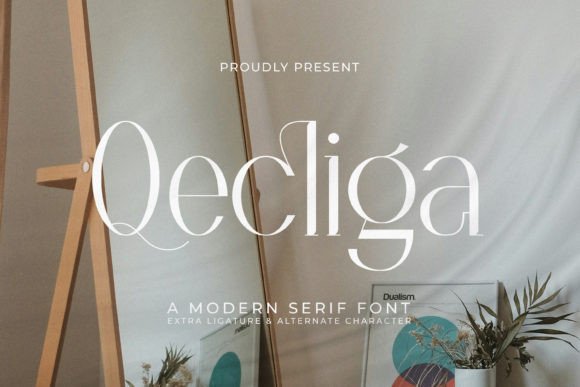
As a maker who designs printable wall art, candle labels, wedding stationery, and SVG cut files for Cricut and Silhouette users, I’m always hunting for a serif font that feels both timeless and fresh—something that elevates my physical products without sacrificing clarity or cut-machine friendliness. That’s why Qecliga has become one of my go-to display fonts: it’s a modern serif typeface with clean lines and gentle curves that never reads as stiff or overly formal. It’s got quiet confidence—like your best linen napkin or a hand-poured soy candle with minimalist branding.
What makes Qecliga especially useful for crafters isn’t just how it looks—it’s how it performs. Its letterforms are generously spaced, with open counters and balanced stroke contrast. That means it cuts cleanly on vinyl at 0.25" height, prints crisply on kraft tags and matte greeting cards, and holds up beautifully in digital mockups—even when scaled down for Etsy thumbnails or Instagram product previews. Unlike some delicate serifs that blur or collapse at small sizes, Qecliga stays legible and elegant whether you’re labeling a 2-ounce bath salt jar or designing a 24"x36" farmhouse-style welcome board.
I’ve used Qecliga across dozens of real product types: vintage-inspired coffee bag labels, botanical wedding invitations (paired with a soft script for names), seasonal printable planner stickers, boutique gift tags, and even heat-transfer vinyl designs for tote bags and ceramic mugs. Its subtle curves add warmth without leaning into whimsy—so it works equally well for a luxury skincare line and a cozy holiday cookie kit. Because it’s a serif font with contemporary proportions, it bridges tradition and trend: customers instantly read it as “thoughtful,” “crafted,” and “intentional.” That perception matters—especially when you’re competing in saturated markets like wedding printables or small-batch food packaging.
For longer text—like product descriptions on hang tags or body copy in printable guides—I don’t use Qecliga alone. It shines brightest as a display font: headlines, titles, monograms, quotes, and decorative phrases. Think “Hand-Poured in Brooklyn” on a candle label, “Est. 2021” on a shop banner, or “You Are Loved” centered on a framed printable. When you need extended readability, I pair Qecliga with a neutral sans serif (like Montserrat or Inter) or a relaxed handwritten font for contrast and hierarchy. That pairing strategy keeps my brand voice cohesive while giving each element room to breathe.
One thing I appreciate is how Qecliga balances visual interest with practicality. It includes standard OpenType features—ligatures for smoother word flow (great for “ff”, “fi”, and “fl” in phrases like “freshly filled”), alternate characters for subtle variation, and consistent multilingual support for common European languages. If you sell internationally or design bilingual baby shower invites, that’s a quiet but meaningful win. File formats include OTF and TTF, so it loads reliably in Canva, Adobe Illustrator, Silhouette Studio, and Cricut Design Space—no rendering surprises mid-project.
Readability tips I’ve learned through trial (and a few ruined sticker sheets): avoid ultra-thin weights for small vinyl cuts—stick to the Regular or Medium if you’re cutting below 0.3". For printed cards and tags, Qecliga’s generous x-height means even 10pt body text remains clear on uncoated paper. And if you’re using it for web-based templates (like editable Canva invitations or Notion planners), its hinting ensures crisp rendering across devices—not fuzzy or pixelated on mobile previews.
Let’s talk commercial use—because this matters deeply if you sell physical goods, digital downloads, or client-branded assets. Qecliga is a commercial font, meaning your license covers use in merchandise (t-shirts, mugs, stickers), physical packaging, client projects, and digital printables you sell on Etsy or Gumroad. You can embed it in PDFs, convert it to outlines for SVGs, and use it across unlimited personal and business projects—as long as you’re not reselling the font file itself. That peace of mind lets me focus on design, not licensing anxiety.
Real-world examples from my own shop: a lavender-scented soap line where Qecliga anchors the front label (“Botanical Soap • Small Batch • Made With Care”) above a simple sans serif ingredient list; a set of printable Easter egg hunt clues where Qecliga gives each clue title gravitas (“The Garden Gate Holds the Next Clue”); and a wedding welcome sign where “Welcome to Our Day” sits in Qecliga while couple names flow in a connected script. In every case, the font quietly signals quality—without shouting.
It’s also surprisingly versatile across seasons and styles. I’ve used Qecliga for rustic fall market banners (“Harvest Market • Oct 12–14”), minimalist New Year’s planner pages (“Intention • Clarity • Growth”), and even playful baby shower invites—just by adjusting size, spacing, and pairing. It doesn’t scream “wedding” or “holiday” on its own, which means it grows with your shop instead of boxing you into one aesthetic.
If you work with physical products—whether you’re printing on recycled cardstock, cutting iron-on for apparel, or layering text over watercolor backgrounds—Qecliga delivers what handmade sellers truly need: beauty that serves function, elegance that scales, and a serif font that feels like a natural extension of your craft. It’s not flashy. It doesn’t distract. But it does make people pause—and that’s exactly how you build recognition, trust, and repeat sales.